
When a man loses the field, he is tempted to believe he has lost himself.
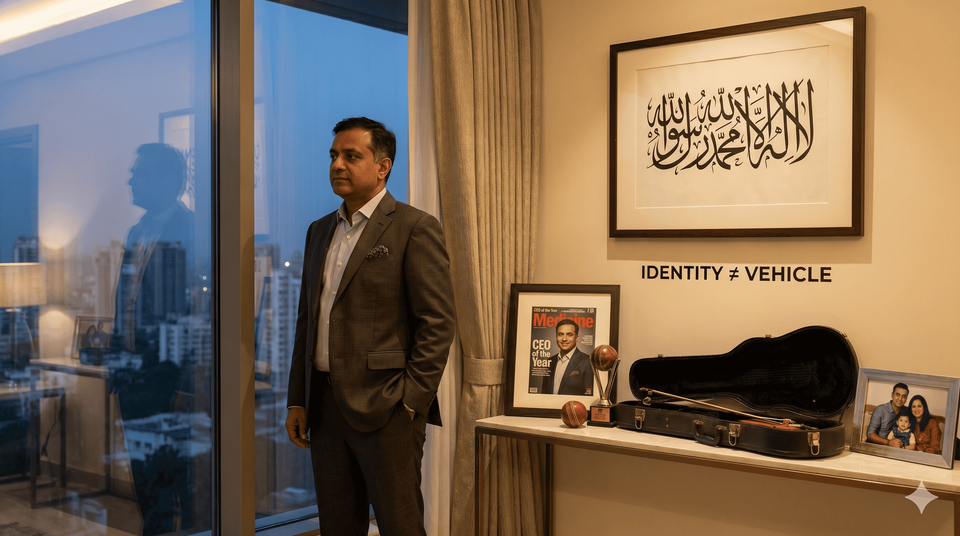
That is the first mistake.
Most people build identity around the visible form of their gift. The athlete says, “I am football.” The musician says, “I am music.” The businessman says, “I am my company.” The father says, “I am my role.” And because the identity is tied to the vehicle, any threat to the vehicle feels like a threat to the self. Injury becomes annihilation. Failure becomes humiliation. Change becomes exile.
But life is rarely so gentle that it allows a man to keep his first definition of himself forever.
Sometimes the body breaks. Sometimes the market shifts. Sometimes a door closes without warning. Sometimes the very thing that once gave a man meaning is taken from him, not because he was unworthy, but because life has no obligation to preserve the structure that helped him feel important.
And that is where the deeper question begins.
Was the gold ever in the field itself?
Or was the gold in the man who learned how to enter a field, suffer for mastery, endure repetition, tolerate frustration, and return again the next day with greater precision than before?
A great footballer who becomes a great musician is not evidence of a lucky second life. It is evidence that the original gift was misunderstood. The gift was never merely speed, coordination, rhythm, or talent in one arena. The real gift was internal. It was the capacity to learn. The willingness to practice. The discipline to refine. The humility to start badly and continue anyway. The endurance to remain in the fire long enough for shape to emerge.
That is why some men collapse when their circumstances change, while others rebuild.
The collapsing man mistakes expression for essence. He thinks the instrument was the music. He thinks the game was the gift. He thinks the title was the power. So when the outer form is stripped away, he stands in the ruins asking, “Who am I now?”
The rebuilding man has discovered something deeper. He knows that the external role was only one container. He knows that what made him dangerous, useful, and alive was never confined to a single craft. He understands that if he could learn one discipline, he can learn another. If he could submit himself to one process of transformation, he can submit himself to another. He may grieve the loss, but he is not destroyed by it, because he was never identical to the thing he lost.
This is a hard truth, because the ego prefers visible identities. They are easier to explain. Easier to display. Easier to admire.
Capability is quieter.
No one claps for a man because he has built the internal architecture of patience. No one hands out medals for the ability to tolerate the boredom of repetition. No one posts tributes to a man because he knows how to begin again without resentment. Yet these are the deeper powers. These are the furnaces where durable identity is made.
The world teaches men to chase performance. Life, eventually, teaches them to value formation.
Performance can be taken away. Formation remains.
That is why loss, painful as it is, can become revelation. It exposes whether a man has built himself around applause or around process. Around image or around substance. Around a particular arena or around the deeper capability that can move from arena to arena without losing its integrity.
This is the hidden mercy inside disruption: it forces the distinction between the vehicle and the driver.
Football may end. Music may begin. Business may fail. Another calling may rise from the ashes of the first. The surface changes. The underlying pattern remains. The man who knows how to learn, adapt, and forge meaning through disciplined effort carries his real wealth with him. He is not starting from nothing. He is starting from essence.
And that changes everything.
Because once a man sees that his true gift is not the role but the capacity beneath the role, fear loosens its grip. He no longer clings so desperately to a single expression of himself. He can honour what was, without worshipping it. He can mourn what ended, without concluding that he ended with it. He can step into new territory with dignity, because he understands that the same internal forge that shaped him once can shape him again.
The field was never the source.
The song was never the source.
The title was never the source.
The source was the man being formed through practice, pressure, repetition, and surrender to growth.
That is where resilience lives. That is where reinvention becomes possible. That is where identity matures.
A weak identity asks, “What do I do?”
A deeper identity asks, “What have I built within myself that can travel anywhere?”
That is the better question.
Because life will change the stage more than once. It will remove labels, titles, tools, and familiar forms. And when it does, the man who has only loved his vehicle will feel abandoned. But the man who has learned to recognize the forge within will understand something most never do:
The gold was never in one place.
It was in him.





Member discussion